What "applicant tracking" means at small-business scale
An ATS, at its core, does one job: it gives every applicant a status so you stop re-reading the same resume and stop losing track of who you already rejected. Enterprise ATS platforms build a great deal on top of that (interview kits, panel scorecards, approval workflows, compliance tracking for regulated hiring) because their customers run dozens of open roles with dedicated recruiters managing them.
If you are hiring one to ten people a year, most of that layer sits unused. What you actually need is the base layer: post the role, collect applications in one place, mark who is worth a call.
Five ways small businesses actually track applicants
Here is an honest rundown of what each option gets you, and where it breaks down.
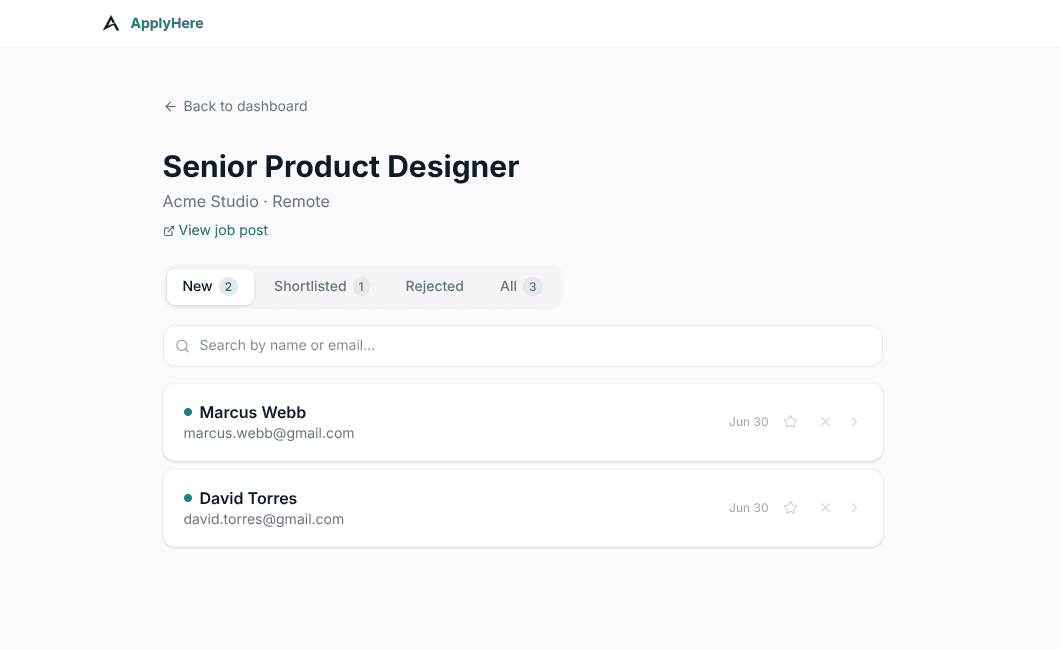
- ApplyHere ($9/post). A guided flow gets a job live in minutes, with a shareable link and a candidate dashboard included. No pipeline stages beyond New/Shortlisted/Rejected, no scorecards, which is the trade for a five-minute setup.
- Breezy HR (free for one role, then $157+/mo). The free tier is genuinely useful for occasional hiring: a careers page, application collection, basic candidate management. Once you need more than one open role at a time, the price jumps.
- Workable (from ~$299/mo for new customers). Built for teams that rely on automatic distribution to 200+ job boards and AI-assisted sourcing. Earns its price at volume; at two or three hires a year you are paying monthly for tooling you rarely open.
- Google Forms + a spreadsheet (free). Genuinely works for very low volume (a handful of roles, a handful of applicants each). What you lose: no status tracking beyond manual spreadsheet edits, no candidate communication built in, and file uploads require the applicant to be signed in to a Google account. Our Google Forms vs. job application software comparison covers this trade in more depth.
- Greenhouse (roughly $5,000–$8,000/yr entry tier). The most capable option on this list, and the most expensive by a wide margin. It is quoted by headcount and requires a sales call to get a number. Built for HR teams running structured, high-volume recruiting, not a founder making their third hire.