Startup hiring has a different shape than enterprise hiring
A startup's first ten hires rarely follow a predictable cadence. You might go three months without an open role, then need to fill two positions in the same week. Enterprise ATS platforms are built around a steady, high-volume pipeline with a recruiter running it full time. A monthly subscription assumes that steady state; a founder hiring irregularly pays for a lot of idle months.
What an early-stage team actually needs is narrower: post a role fast, get it in front of the right people, and keep the handful of applicants you receive organized enough that nobody falls through the cracks. That is a smaller problem than the one Workable or Greenhouse is built to solve. See our broader comparison of ATS options for small business for the full range.
What to actually look for at this stage
- Speed to live. If setting up the tool takes longer than writing the job description, it is the wrong tool for a startup moving fast.
- No cost for idle months. A subscription you pay in months with no open roles is money that could be runway instead.
- A form candidates will actually finish. Early hires are often found through your network and shared on mobile, and a clunky multi-page form loses people who were otherwise interested.
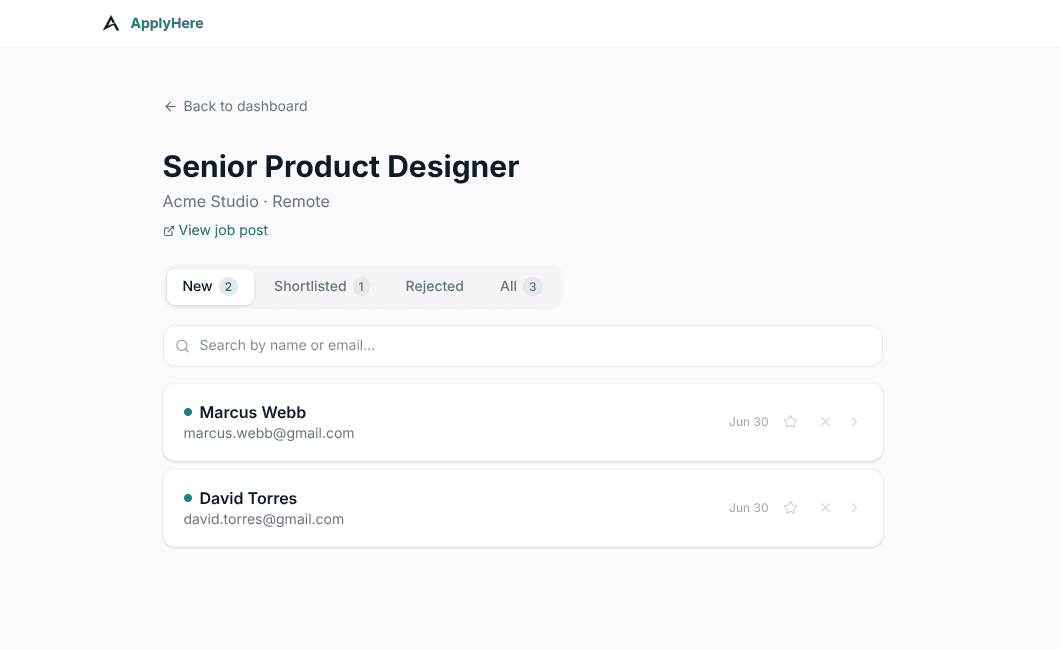
- Just enough tracking. A New/Shortlisted/Rejected status is enough structure for two people evaluating candidates together. You do not need a five-stage pipeline with approval gates for a team of three.
The founder-recruiter reality
At most startups, the person posting the role is also running the interview, checking references, and making the offer, often between building the actual product. A tool that takes an afternoon to configure is an afternoon not spent doing any of that. The bar for a startup ATS isn't feature depth, it's whether a founder can post a role between meetings and trust that nothing falls through the cracks while they're not looking at it.