What "free" usually means on a job board
Most job boards that advertise a free tier mean something narrower than it sounds: one listing, limited visibility unless you pay to promote it, and often no application tracking at all. You get an inbox full of emails or a link to a resume, not a system. LinkedIn's free tier is genuinely useful for professional roles but caps you at one listing at a time with no algorithmic boost. Jotform's free plan caps you at 100 submissions a month across five forms. Typeform's free plan caps at 10 responses a month and excludes file uploads entirely.
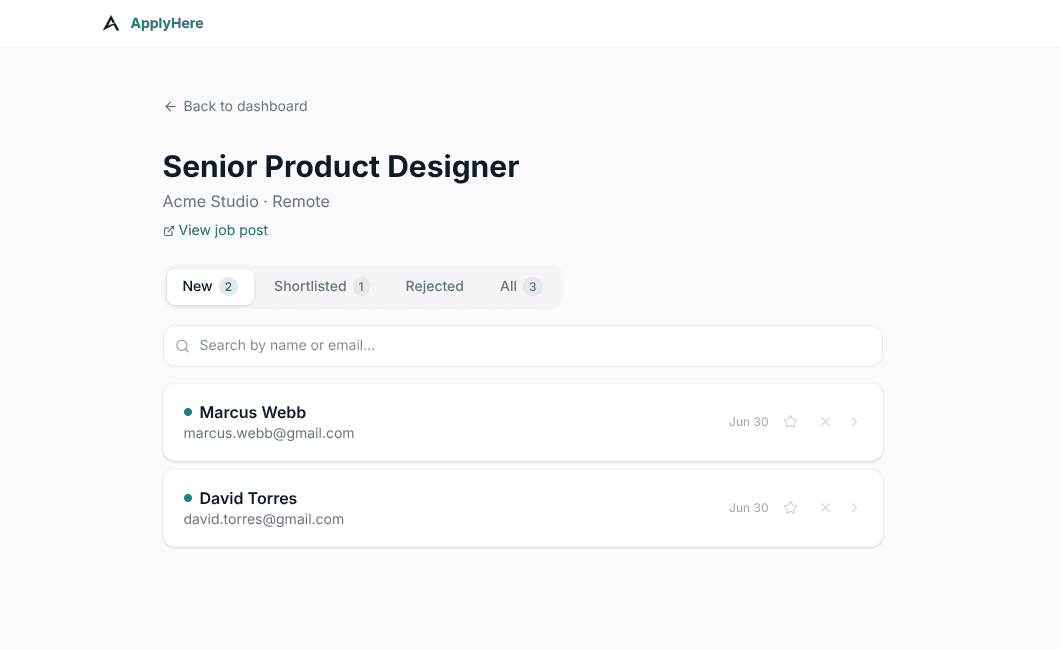
ApplyHere's free tier is different in kind: your first job post is the full product, not a stripped-down version of it. Unlimited applicants, a custom screening flow, and a real applicant dashboard: free, with no card required, because we would rather you see exactly what you are paying $9 for on the next one.
The tradeoff on truly free tools
A Google Form costs nothing and can genuinely work for very low volume: a role or two a year with a handful of applicants each. What it does not give you: candidate status tracking beyond manually editing a spreadsheet, resume uploads without the applicant signing into a Google account, or a way to email a shortlisted candidate without leaving the sheet. For a deeper look at exactly where that breaks down, see our Google Forms vs. job application software comparison.
Why the second job costs $9
The free first post exists so you can evaluate the product with nothing at stake. After that, ApplyHere charges per post rather than per month, which matters if you hire irregularly: a business that fills two roles a year pays $9 twice, not a subscription running the other fifty weeks for nothing.